In 2026, kitchens and home bars often serve as places to eat, work, and talk. A stool that turns can make those small transitions feel easier. Why are swivel bar stools more popular than fixed ones? For many households, the answer is simple: people can face the counter, a guest, or the rest of the room without dragging the stool across the floor. That can be useful when space is tight. It is not a universal preference, though. Some people value the steadiness and straightforward design of a fixed seat more.
The difference becomes clear during everyday use. Someone preparing dinner can turn toward a family member, then face the countertop again. At a bar, guests can join a conversation without shifting their whole seat. Small details matter: a smooth swivel, a comfortable footrest, and a stable base can affect the experience more than appearance alone. Poorly made mechanisms may wobble or become noisy over time, so checking construction and the manufacturer’s care guidance is sensible. A swivel is not automatically better.
This article explores the practical reasons behind the trend, along with the trade-offs buyers should consider. Room layout, seat height, materials, and household habits all influence which style works best. A fixed stool may be the better fit for a quiet breakfast nook or a home where simplicity matters most. The choice is less obvious than it first seems. The right stool should feel comfortable in your actual space, not just look appealing in a product photo.
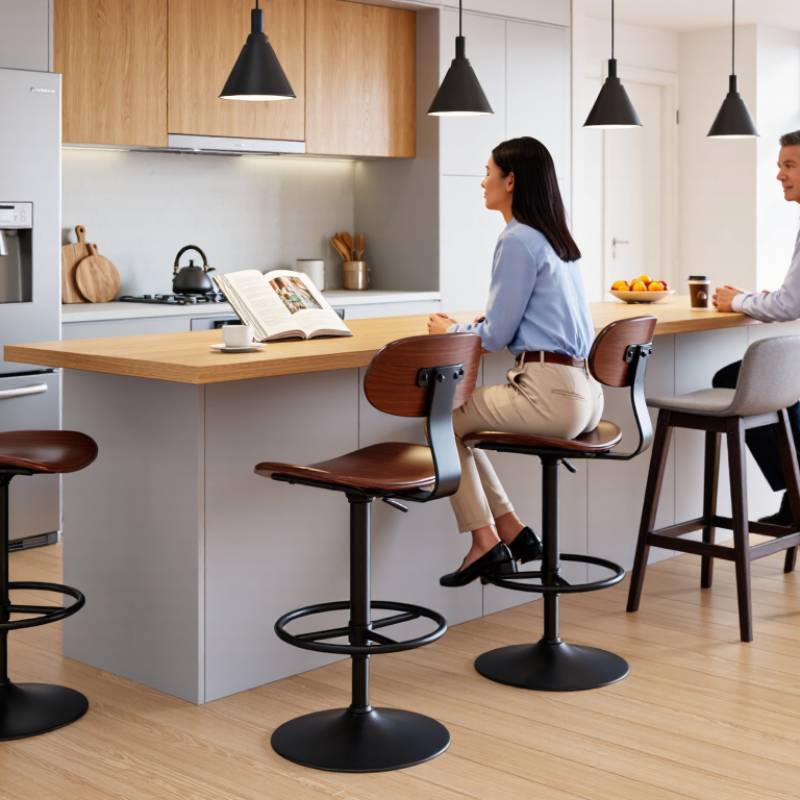
A swivel bar stool turns on a central bearing; a fixed model stays facing one direction. That small difference changes everyday use. At a kitchen island, a seated person can turn toward a conversation, reach for a plate, or step down without dragging the stool across the floor. Fixed stools offer a steadier, simpler feel, especially where people sit briefly or where a clean line of seats matters. No rotation. Less movement to maintain.
The distinction matters in busy hospitality spaces, too. The National Restaurant Association’s 2024 State of the Industry report projected U.S. restaurant sales at $1.1 trillion, reflecting the scale of settings where seating must support frequent use. That figure does not show that swivel stools outsell fixed ones; it gives useful context, not proof of preference. In practice, swivels add a bearing and more moving parts, which can loosen or collect grit over time. Fixed models avoid that mechanism, though guests may need to pull them out and reposition them. Check seat height, footrest placement, and the stool’s stability before choosing. A smooth swivel can feel effortless in a showroom, yet everyday comfort depends on the counter, the user, and the space around it.
| Comparison Dimension | Swivel Bar Stools | Fixed Bar Stools |
|---|---|---|
| Seat movement | The seat rotates around a central swivel mechanism, allowing the user to turn without moving the stool base. | The seat stays in a fixed orientation; users usually turn by moving their body or repositioning the stool. |
| Getting on and off | Rotation can make it easier to face away from the counter while sitting down or standing up, especially where access is tight. | Works well when there is enough space to approach the seat directly and move around it. |
| Conversation and shared spaces | Makes it convenient to turn between a counter, nearby seating, and other people without shifting the base. | Provides a consistent forward-facing position, which may suit a row of stools or a more orderly seating layout. |
| Movement around the counter | Users can change their viewing direction while the stool remains in place. The base still needs sufficient clearance from nearby furniture. | Changing position generally requires turning the body or moving the stool, which can take more effort in a crowded layout. |
| Construction | Includes a rotating connection beneath the seat. The design and service requirements depend on the specific mechanism. | Has no seat-rotation mechanism, so its construction is generally more straightforward. |
| Wear and upkeep | The swivel joint is an additional moving component and may need inspection or maintenance according to the manufacturer's instructions. | With fewer moving parts, there is no swivel joint to maintain; other components can still wear with use. |
| Stability and movement | Stability depends on the stool's base, materials, assembly, and weight rating. The rotating seat does not replace the need for a stable base. | Stability also depends on the base, materials, assembly, and weight rating. The seat itself does not rotate. |
| Best suited to | Kitchen islands, home bars, and social spaces where users often turn to talk or move between activities. | Dining counters, compact layouts, or settings where a stationary, consistently aligned seat is preferred. |
| Choosing the right model | Check seat height, overall dimensions, rotation action, base clearance, and the manufacturer's stated weight capacity. | Check seat height, overall dimensions, footrest position, base clearance, and the manufacturer's stated weight capacity. |
Note: Features and dimensions vary by model. This comparison describes general design differences and does not represent measured market-share or popularity data for 2026.
A swivel stool turns on a central bearing. A fixed stool stays facing one direction. Simple distinction.
It lets someone turn toward the cook or reach for a plate without dragging the stool. Handy, but the room needs turning space.
Usually, yes. They have no swivel bearing to loosen or collect grit. Fewer moving parts.
No. Comfort depends on seat height, footrest position, and the person using it. A smooth showroom turn can mislead me.
Check its height, footrest, stability, and clearance around it. Test it on your actual floor if possible.
They can, if there is little room to turn. Measure the space around the island before buying.
Not by themselves. Seat height, stability, and room to move also matter. One rotating seat is no complete solution.
An island may serve as a breakfast counter, homework spot, and conversation area. Swiveling helps people turn between activities.
A 2024 survey found that 79% of buyers considered an island essential or desirable. That does not prove they prefer swivel stools.
This article explores why are swivel bar stools more popular than fixed ones in 2026, beginning with the practical difference: a swivel seat turns while its base stays in place, whereas a fixed stool faces one direction. That simple motion can make it easier to sit down, leave the counter, turn toward a conversation, or reach nearby items without shifting the entire stool. In homes and social spaces where people move between cooking, dining, and chatting, flexible seating can feel especially convenient.
The article also considers how changing preferences for comfort, adaptable layouts, and accessible seating are shaping stool design. Features such as supportive seats and footrests may improve everyday use, while buyers still weigh price, stability, and maintenance. Swivel models can offer added convenience, but they need a dependable base and may require attention to moving parts. Ultimately, the right choice depends on the room, the people using it, and whether easy movement is worth more than the simplicity of a fixed seat.

 Nichols furniture